Helios improves medication safety
The process begins with medication prescribed by the hospital’s physicians. Instead of being recorded on paper, prescriptions are entered directly into the digital medication system and linked to the patient’s medical record. The system automatically warns of potential drug interactions and duplicate prescriptions. In the second step, pharmacists professionally review each prescription: Is the dosage appropriate for the patient’s kidney function? Are the medications compatible? Can the tablet be divided?
In the third step, the hospital pharmacy prepares each patient’s medication individually using a process known as Unit Dose. An automated system packages the medications individually in small pouches and prints a unique barcode on each one.
Annika Demuth, pharmacist and Head of E-Medication and Digitalization at Helios, explains: “With Unit Dose, the right medication is prepared in the correct dosage and for the right administration time. The fourth step — scanning the medication and the patient’s wristband at the bedside — is new.” And this step is crucial.
“The idea behind Closed-Loop Medication Management, or CLMM for short, is simple: the safe, digital journey of a medication should remain uninterrupted at every stage — from prescription to the moment the patient receives the tablet.”— Prof. Dr. Olaf Kannt, Head of Medical Management, Executive Leadership Team, Helios Germany
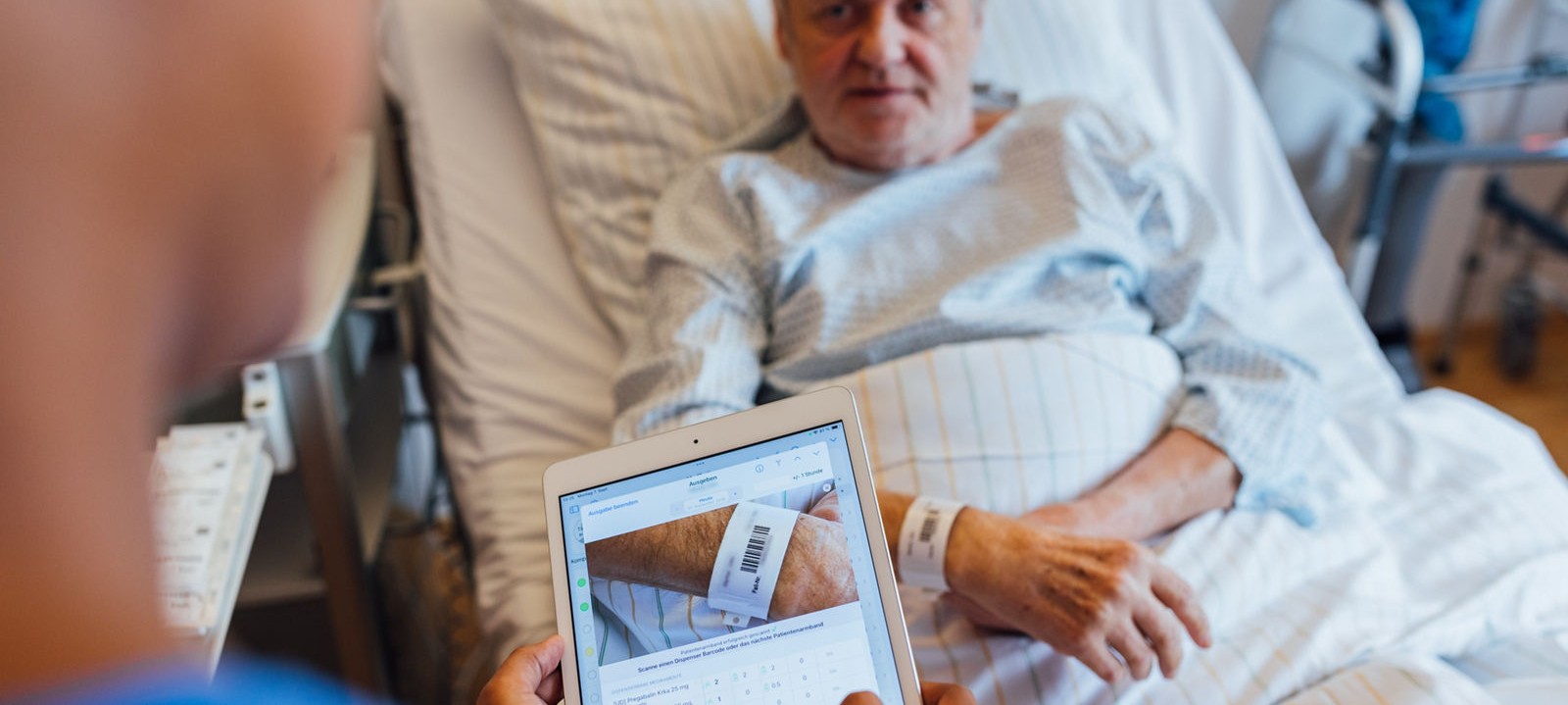
Until now, the digital chain ended at the ward door. What happened after that relied on the careful work of nursing staff. With the introduction of the Bedside Scan, this final step is now digitally safeguarded as well. At the patient’s bedside, a nurse scans two things: the patient’s wristband and the medication pouch. In the same instant, the system checks both against the current prescription, verifying the patient, medication, dosage, dosage form, and administration time. If anything does not match, the system issues an alert before the medication is administered. The administration is also documented automatically at the same time.
“The process innovation can be summed up in one sentence: Unit Dose ensures that the medication pouch contains the right medication. The digital Bedside Scan ensures that it reaches the right patient,” says Prof. Dr. Olaf Kannt.
The concept, including the Bedside Scan, is already in use at two Helios hospitals, with the rollout underway at another twelve. By the end of 2027, all approximately 80 Helios locations in Germany are expected to be connected to the system.
Closed-Loop Medication Management (CLMM)
The system closes the gap between medication prescription and administration. The process consists of four steps:
- physicians prescribe medications digitally through the electronic patient record. Automatic alerts for potential drug interactions and duplicate prescriptions help improve safety.
- pharmacists individually review every prescription, from the appropriate dosage to medication compatibility.
- at the hospital pharmacy, medications are automatically prepared for each individual patient and packaged separately. A barcode on each medication pouch ensures that the right medication is ready at the right time.
- at the patient’s bedside, a nurse scans both the patient’s wristband and the medication pouch. The system checks the data against the prescription in real time. If anything does not match, medication administration is stopped.
Despite the increasing use of digital processes, human expertise remains indispensable. “However, the scan cannot replace a nurse who notices that a patient’s condition is different today than it was yesterday, or a pharmacist who identifies a drug interaction. It takes over the routine checks that technology can perform more effectively, leaving more time for what only people can do,” comments Sebastian Hunger, Director of Nursing at Helios Park Hospital Leipzig.
Another important benefit of the system becomes particularly evident when patients are unable to communicate clearly or verify information themselves — for example, after surgery, in cases of dementia, or when language barriers are present.
Patients can also contribute to safer care:
- Bring an up-to-date list of your medications with you — ideally, along with the medication packages.
- Inform the medical team about any dietary supplements, vitamins, or other products you are taking.
- Ask questions if anything seems unfamiliar or unclear. Your questions are always welcome.
Read more:
Do you need more information about Helios Hospitals or want to schedule your treatment?