Robotic surgery for colon cancer using the da Vinci system
Robotic-assisted surgery is a minimally invasive technique. Similar to laparoscopy, also known as keyhole surgery, the procedure is performed through small incisions using a camera and instruments measuring only a few millimetres in diameter. What is new, however, is that the camera and instruments are now controlled by the surgeon with robotic assistance, while the system also provides a range of additional capabilities.
How is the da Vinci robot designed
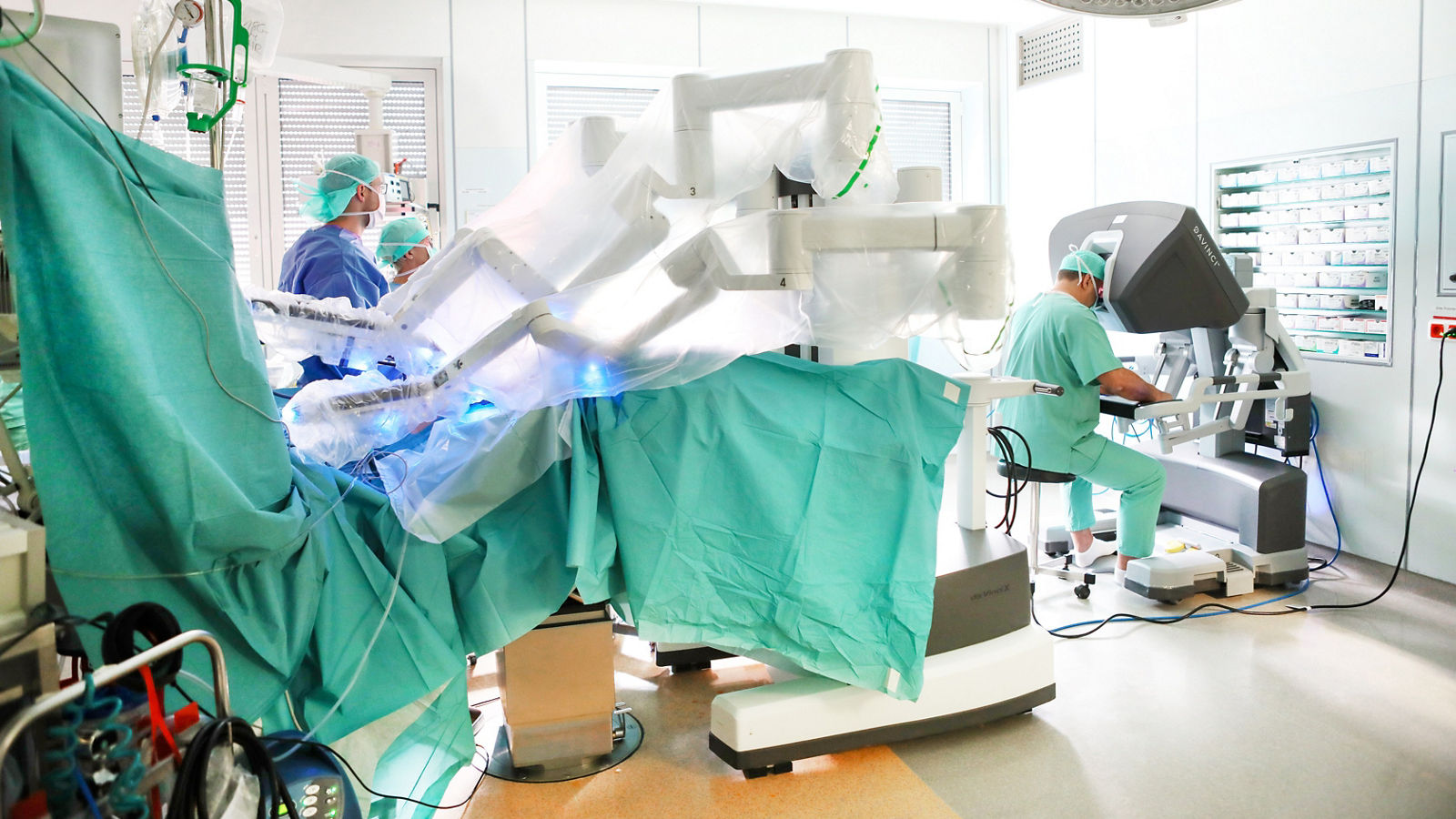
Dr Mille: The da Vinci system essentially consists of three components: the patient cart, the vision cart and the surgeon console. The patient cart is the operative component of the system and has four robotic arms. It is positioned next to the patient, the individual arms are connected to the ports placed in the patient, and the appropriate surgical instruments are then inserted.
The console, on the other hand, is the surgeon’s workstation. Here, the surgeon sees a highly magnified, three-dimensional, high-definition image while simultaneously controlling the da Vinci arms and instruments with the highest level of precision using special hand controls, or joysticks.
The vision cart acts as the “brain” of the da Vinci system, connecting all of its components. It also features a monitor that allows the assisting staff at the operating table to see the same image provided by the da Vinci system.
How exactly does the da Vinci robot assist the surgeon
Dr Mille: The system provides support on several levels. First, the surgeon at the console receives a magnified, true-to-life, three-dimensional view of the surgical field. Even the smallest anatomical structures, such as blood vessels and nerves, can be seen in great detail. This is particularly beneficial for nerve-sparing surgery and procedures aimed at minimising blood loss.
When it comes to controlling the instruments, the da Vinci system filters out natural hand tremors and unwanted movements, ensuring that the instruments remain steady and stable at all times. The instruments themselves also provide an entirely new level of freedom of movement.
In conventional laparoscopy, we mainly use rigid instruments with a limited range of motion. The da Vinci instruments offer significantly greater flexibility. They have seven degrees of freedom and can rotate through 540 degrees — exceeding the range of motion of the human hand.
What are the particular advantages of the da Vinci robot in colorectal cancer surgery?
Dr Markus Mille: The high-definition image and improved surgical precision offer significant advantages in colorectal cancer surgery. In particular, surgery for rectal cancer requires a radical oncological approach within the pelvis while also preserving the surrounding nerves as much as possible. This is where the robotic instruments and excellent visualisation really demonstrate their strengths, enabling highly precise surgery within a very confined space.
In colon surgery, the da Vinci system also helps overcome technical limitations and achieve the best possible treatment outcome.
When does it make sense to use a surgical robot for colorectal cancer surgery?
Dr Mille: In principle, a minimally invasive approach should always be considered for colorectal cancer surgery whenever possible. The more complex the procedure, the more the da Vinci robot can demonstrate its capabilities and advantages.
For example, if colorectal cancer surgery cannot technically be performed laparoscopically, it should be assessed whether a robotic-assisted approach is feasible. Using the da Vinci system can also significantly increase the proportion of minimally invasive procedures. At Helios Hospital Erfurt, we now perform more than 80% of our intestinal procedures robotically, and we see the benefits for our patients almost every day.
What are the main benefits of the da Vinci system for patients undergoing colorectal cancer surgery?
Dr Mille: Thanks to the small incisions and reduced trauma to the abdominal wall, patients experience significantly fewer limitations after robotic-assisted colorectal cancer surgery. Reduced blood loss and less pain also contribute to a faster recovery, which continues to impress even us.
The cosmetic benefit compared with a large abdominal incision should not be overlooked either. In addition, using the da Vinci system can contribute to a lower incidence of bladder dysfunction or anal sphincter weakness, as well as a faster recovery of bowel function, particularly following rectal surgery.
What are the disadvantages of robotic-assisted surgery?
Dr Mille: At present, the system does not provide tactile feedback during surgery. This means that we cannot directly feel or palpate tissue with the robotic instruments. However, during training as a console surgeon, you quickly develop a form of visual tactile perception, and the brain rapidly learns to compensate for the lack of direct touch. In other words, we learn to “feel with our eyes,” which largely compensates for this disadvantage.
One of the main criticisms of robotic-assisted procedures and systems remains the high cost of purchasing the equipment and consumable materials. Of course, patients do not incur any additional costs or co-payments for the use of the da Vinci system, but the expense is one reason why these surgical systems are not yet available everywhere.
From a technical perspective, however, I personally see no significant disadvantages. Instead, I regard robotic-assisted surgery as a genuine milestone in surgery, comparable to the introduction of laparoscopy.
How long does colorectal cancer surgery with the da Vinci system take?
Dr Markus Mille: Preparing the da Vinci system for surgery is certainly somewhat more involved than preparing for a laparoscopic procedure. However, depending on the surgeon’s experience, the actual operating time is relatively similar to that of other minimally invasive techniques. Of course, it also depends on which part of the bowel is being operated on. Operating times of two to four hours are quite normal.
What has your experience with the da Vinci robot in colorectal cancer surgery been so far?
Dr Mille: The da Vinci robot enables us to further increase the proportion of minimally invasive procedures in colorectal cancer surgery. Increasingly complex procedures can be performed safely and precisely using minimally invasive techniques. This offers significant benefits for patients, particularly in terms of recovery and a shorter hospital stay. For this reason, robotic-assisted surgery has now become our preferred surgical approach for colorectal cancer operations.
Colorectal cancer diagnosis
A diagnosis of colorectal cancer requires timely treatment tailored to the individual patient. Modern robotic-assisted surgery with the da Vinci system expands the possibilities of minimally invasive procedures, enabling surgeons to operate with a high degree of precision even in complex cases. Small incisions, reduced tissue trauma and blood loss, less postoperative pain, and faster recovery are important benefits of this approach for patients. The decision to use a robotic-assisted surgical system is always made on an individual basis, taking into account the location of the tumour, the complexity of the procedure, and the patient’s overall condition.
If you are interested in arranging colorectal cancer treatment at one of the Helios hospitals, you can submit an enquiry using the contact form on our website or email us at the address provided at the top of the website.
Learn more about arranging treatment at Helios hospitals ⟶
Read more:
Do you need more information about Helios Hospitals or want to schedule your treatment?